

Proven Online Marketing Systems for Entrepreneurs
Magnetix Marketing
Our simple mission is to empower entrepreneurs and companies to generate currency, success, and financial freedom with proven online marketing systems.
Success leaves clues. Systems create momentum.
The currents are already there—we help you connect to them.
The Latest Buzz!
Free of Charge!
Plug into
⚡The Currents⚡
A weekly exploration of marketing, branding, entrepreneurship, and the hidden currents that shape the way we think, buy, build, and grow.
Not another newsletter.
A conversation worth looking forward to.
To what email should we be sending The Currents?
Your Information is Secure with Us and will NOT be Sold or Distributed
Build the system that makes your vision inevitable.
Our NEW Powerful Progress Program is a step-by-step video training platform designed to help you turn ideas into working, magnetic marketing systems — without burnout, debt, or overwhelm.
If you want to:
increase income
attract leads and paying clients
grow an online presence that actually compounds
expand a professional or local business
or finally bring a long-held idea into the world
This is where you begin.
After helping hundreds of businesses, one truth became unavoidable:
The dream was never the problem.
The system behind it was.
Most businesses fail not because they lack talent or effort — but because progress becomes expensive, exhausting, and unsustainable long before momentum can take hold.
The solution isn’t harder work or better motivation.
It’s building the right structure — one that fuels steady progress, adapts to your needs, and grows with you.
Start with the diagnosis.
Before tools.
Before tech.
Before tactics.
Download the free guide:
The Circuit Board for Your Dreams
Connect Your Vision Into Reality
A realistic framework for turning vision into momentum - without debt, burnout, or shortcuts.
This guide explains:
why so many businesses stall at every stage
how momentum actually compounds
and how to build a ramp toward success that works for any size vision
It’s available free in PDF, audio, and video so you can absorb it however you prefer.
No pressure.
No pitch.
Just clarity.
Get it today by clicking this link below.
Magnetix Marketing IS currently enrolling clients!
More opportunities are lost to simple procrastination than for any other reason. It's perhaps the most human thing we share.
As we are extremely generous with the services we deliver, we cannot enroll many direct clients, so we have NO CHOICE but to be selective with whom we serve at the highest levels. Training programs are growing quickly, however, so it's very likely that no matter what you're trying to achieve, we will be able to light the way.
There are such a wide variety of goals we can help you achieve that you owe it to yourself to have a quick chat with us. We will explore your objectives, wants and needs, and help you to find where our programs can overcome your obstacles. There is almost always some degree to which we can assist.
Click now to set up a Magnetix Meeting via phone or zoom. No time to waste in pursuit of your goals!
Join the Magnetix Marketing Community

Marketing doesn't have to be a lonely journey.
Inside the Magnetix Marketing Community, you'll connect with fellow entrepreneurs, business owners, creators, and dreamers who are all working to attract more opportunities, build stronger systems, and create lasting momentum.
Share ideas, ask questions, discover new strategies, participate in discussions, collect Sparks, and learn alongside others who are navigating the same challenges and opportunities you are.
Whether you're just getting started or looking to take your marketing to the next level, you'll find insights, support, resources, and the occasional rabbit hole worth exploring.
Come plug into the conversation. Its even FREE!
Your next Spark may be waiting.
Magnetix Marketing Musings
(Better known as our Blogs!)

The Elephant in the Video
The Elephant in the Video
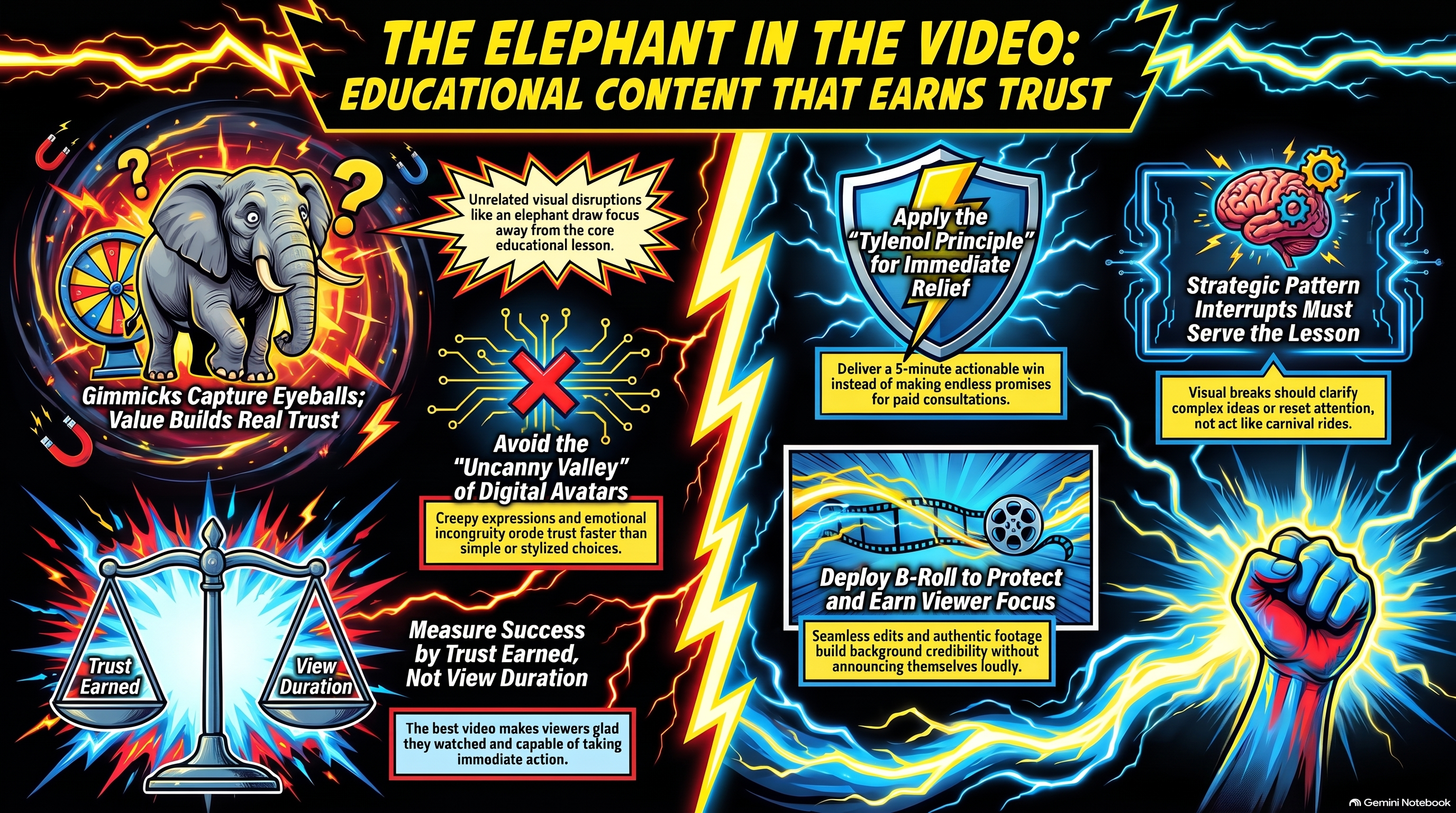
Why Capturing Attention Isn't the Same as Teaching Something Worth Remembering
Magnetix Marketing | Business Brain Builder — Packet 050 Companion Blog | Version 2
Imagine you're watching a video about an important business problem. The presenter is explaining something that could genuinely improve your life. They're knowledgeable, articulate, and clearly passionate about helping you understand the subject.
Then an elephant walks across the screen.
Not a metaphorical elephant. An actual elephant. Or at least a remarkably convincing digital one.
You stop thinking about the business problem.
You're thinking about the elephant.
Which, from a certain marketing perspective, might be considered a spectacular success. You were paying attention, after all.
But here's the question that deserves a little more consideration: Were you paying attention to the right thing?
Welcome to one of the great paradoxes of modern video marketing. We have more tools than ever to capture attention, yet we're not necessarily getting any better at making that attention worthwhile.
And with artificial intelligence giving practically anyone the ability to produce increasingly sophisticated videos, it's becoming a question every business owner should consider.
The Attention Economy Has a Strange Sense of Humor
Once upon a time, making a professional-looking video required cameras, lighting, microphones, editing equipment, and someone who knew what to do with all of them.
Today, you can write a script, select a digital presenter, generate a voice, add music, and produce something resembling a television commercial without ever standing in front of a camera.
That's a remarkable development. It makes capabilities once reserved for businesses with substantial production budgets accessible to entrepreneurs working from their kitchen tables.
But accessibility introduces another challenge.
When everyone can produce a polished video, polish stops being particularly remarkable.
So we reach for something else.
Faster cuts. Bigger captions. Animated graphics. Dramatic zooms. Sound effects. Surprising visual interruptions. The occasional elephant.
In video production, these changes are often called pattern interrupts. They're designed to break the viewer's expectations and renew attention before the mind wanders elsewhere.
Used thoughtfully, they're valuable. A change in perspective can emphasize an important point, clarify a difficult concept, or give the audience a moment to reset.
Used indiscriminately, however, they turn a lesson into something resembling a carnival ride.
And there's a rather important distinction between keeping someone awake and helping someone learn.
Five Minutes of Fame, or Five Minutes of Value?
Let's consider two hypothetical videos.
The first begins with an irresistible hook, introduces a mysterious problem, teases three extraordinary secrets, and spends several minutes promising that the viewer is about to discover something amazing.
Just when the explanation should arrive, the presenter announces that the real answer is available after scheduling a consultation.
The second video identifies a specific problem, explains something useful about it, demonstrates a practical solution, and gives the viewer enough understanding to accomplish something immediately.
At the end, the presenter offers additional help for anyone who wants to take the next step.
Both might generate leads.
But only one has actually delivered the education it promised.
At Magnetix Marketing, we think of this as the Tylenol principle.
If someone has a headache, they don't want an elaborate presentation about the history of headaches followed by an invitation to purchase a bottle of Tylenol. They want something that helps with the headache.
Educational marketing should operate on a similar principle.
A short video doesn't need to solve every problem your customer will ever face. It should, however, deliver one meaningful improvement that stands on its own.
Perhaps the viewer learns how to identify an expensive mistake in their business. Perhaps they discover a better way to approach a difficult conversation, evaluate a decision, or complete a small task that has been frustrating them.
The result should be achievable, useful, and relevant.
And if that experience makes them curious about what else you could help them accomplish?
Wonderful.
You've earned that curiosity instead of manufacturing it through an unfinished promise.
When the Presenter Becomes the Problem
There's another fascinating complication in our increasingly automated video world.
Sometimes the technology intended to make the presentation more professional becomes the most distracting thing in it.
I learned this firsthand while working with early generations of AI-generated video avatars.
We were experimenting with technology that could reproduce a person's appearance and use that digital likeness to deliver scripted presentations. The ambition was understandable: create a repeatable, scalable video production method that could work for virtually every customer.
And sometimes it worked beautifully.
Other times?
Well, let's just say the software appeared to have developed some rather creative interpretations of human facial expressions.
Imagine a business owner delivering a thoughtful, deadly serious explanation of an important subject while their digital counterpart blinks at peculiar intervals, contorts its face, makes inexplicable gestures, and generally behaves as though it's receiving conflicting instructions from several invisible puppeteers.
The production room occasionally became a comedy club.
There were moments when people were quite literally falling out of their chairs laughing.
Of course, the business owners whose reputations were attached to these presentations would not have found the situation nearly as entertaining.
And therein lies the lesson.
Just because technology can reproduce your face doesn't mean it can reproduce your presence.
A person's credibility isn't communicated through facial resemblance alone. It's conveyed through timing, expression, tone, posture, emotional appropriateness, and countless subtle behaviors that we often recognize without consciously examining them.
When those elements don't agree with the words being spoken, the result can be unintentionally hilarious.
Or profoundly unsettling.
Which brings us to a rather peculiar place.
Welcome to the Uncanny Valley
In 1970, Japanese roboticist Masahiro Mori introduced an idea that became known as the Uncanny Valley.
The basic observation is that as artificial characters or machines become more humanlike, people may initially find them increasingly familiar and relatable.
A friendly cartoon robot? Charming.
A clearly animated human character? Perfectly acceptable.
A remarkably realistic digital human whose eyes, expressions, and movements are just slightly wrong?
Suddenly, something feels off.
The closer the artificial representation approaches human realism, the more noticeable certain imperfections can become. Instead of increasing our sense of connection, the almost-human appearance may produce discomfort.
That's the valley.
The concept isn't a universal law, and people's reactions vary. But it provides a useful framework for understanding why certain digital presenters feel engaging while others leave viewers wondering whether they should continue watching.
And there's another problem that can accompany it: emotional incongruity.
Suppose your AI presenter is discussing the financial strain of a struggling family business while wearing an enormous, inexplicable smile.
Or explaining a sensitive personal issue while making gestures better suited to an enthusiastic game-show host.
Even if the avatar looks convincing in a still image, its behavior may undermine the message.
The technology isn't merely failing to look human. It's failing to behave appropriately for the conversation.
And in marketing, where trust is often the most valuable thing we're trying to establish, that matters enormously.
Why a Talking Pineapple Might Be More Believable
Here's where things become wonderfully strange.
A talking pineapple might make a better video presenter than a nearly photorealistic human avatar.
Not because anyone seriously believes pineapples can talk.
Quite the opposite.
Nobody expects a pineapple to behave like a human being.
Give it a cheerful expression, a recognizable personality, and a voice that fits the subject, and viewers can accept the entire arrangement as playful storytelling.
The character has made its intentions clear.
A digital human, however, makes a different promise.
Its appearance invites us to expect human behavior. When the performance doesn't deliver, the gap between expectation and reality becomes distracting.
That doesn't mean cartoon characters are always preferable, or that AI avatars should be avoided.
Today's synthetic presenters are considerably more capable than many of their predecessors. Some can be effective in the right circumstances, and improvements continue.
But the relevant question isn't whether the technology has become impressive.
The relevant question is whether this particular presentation helps this particular audience trust and understand this particular message.
A whimsical character might be delightful in a marketing tutorial and completely inappropriate for a conversation about grief.
A realistic avatar might work well for a straightforward product explanation yet feel strangely impersonal when discussing a deeply emotional subject.
And a real business owner, speaking naturally into an ordinary camera, may create a stronger connection than a technically flawless digital substitute.
Sometimes the imperfections of a real human being are precisely what make the communication feel authentic.
The Elephant Has a Job to Do
Let's return to our elephant.
There are situations where an unexpected visual interruption can make an educational video more effective.
Suppose you're explaining how business owners often ignore the biggest problem in their operations because they're overwhelmed by smaller emergencies.
An elephant appearing briefly in the background could be a funny, memorable way to illustrate the proverbial elephant in the room.
Now the surprise serves the lesson.
It reinforces the idea, gives the audience a visual memory, and perhaps makes the explanation easier to recall later.
But if the elephant appears simply because someone thought the video needed something exciting at the forty-five-second mark, it may accomplish little beyond interrupting the viewer's concentration.
The same principle applies to B-roll, animated diagrams, changing camera angles, music, captions, and visual effects.
Every production choice should have a reason.
And not every reason involves making the audience notice something.
Some of the most valuable visual techniques work precisely because the audience doesn't notice them at all.
When the Best Visual Effect Is the One Nobody Notices
Imagine a presenter delivering a valuable explanation but stumbling over a sentence.
The editor removes the mistake, only to discover that the presenter's head suddenly jumps between two positions. The resulting jump cut creates a distracting visual discontinuity.
The viewer might not consciously identify what happened. But the abrupt change can momentarily pull attention away from the lesson.
Cover that transition with a few seconds of relevant footage, however, and the explanation continues naturally. The audience sees something that supports the subject while the awkward edit disappears beneath it.
The viewer may never realize an edit occurred.
And that's precisely the point.
B-roll can illustrate a concept, reinforce an emotion, provide context, introduce variety, or simply make an otherwise awkward transition feel seamless.
The best visual decision isn't necessarily the one that captures the most attention. Sometimes it's the one that protects the attention we've already earned.
Good editing doesn't always announce itself. Sometimes it quietly gets out of the way of the lesson.
Sometimes B-Roll Tells Us Who's Talking
There's another job B-roll can perform that has little to do with explaining the lesson or hiding an edit.
It can establish context and credibility.
Imagine listening to a business consultant discuss leadership while a brief clip shows that same consultant addressing a packed conference room. Or watching a chef explain a cooking technique while seeing them at work in a professional kitchen.
The footage communicates something the spoken presentation might otherwise need several sentences to establish: this person has relevant experience beyond the chair they're sitting in.
That doesn't make every claim they offer automatically true, of course. But authentic glimpses of someone's work can help viewers understand why the presenter might be worth listening to.
A business coach facilitating a workshop, a contractor inspecting a completed project, or an educator interacting with students can all provide meaningful visual context.
And there's a critical distinction between demonstrating credibility and manufacturing it.
Real footage of a speaking engagement is evidence of an experience. Artificially creating an audience that never existed is an attempt to borrow credibility that hasn't been earned.
The most persuasive proof of experience is often simply allowing people to see it.
Sometimes the Visuals Help Us Feel the Lesson
And then there's the emotional dimension.
Imagine someone explaining the frustration of running a business that consumes every waking hour.
We could show an animated clock spinning faster and faster.
Or we could briefly show an exhausted business owner sitting alone in a darkened office while the rest of the family enjoys an evening together.
Both visuals communicate something, but they do so differently.
One illustrates the pressure of time. The other gives that pressure a human context.
Neither is automatically better. The right choice depends on the audience, the lesson, and the emotional experience we're trying to create.
But it's worth recognizing that visual storytelling can do more than explain what something means.
It can help people understand why it matters.
That power deserves some restraint, too. Emotionally charged footage shouldn't exaggerate a problem, imply that staged events are real, or manipulate viewers into conclusions the evidence doesn't support.
The purpose is to deepen understanding, not manufacture distress.
And that brings us to a useful distinction.
Don't ask what you can put on the screen to keep people watching. Ask what the viewer needs to see to better understand, believe, or feel what you're saying.
Sometimes that's a diagram. Sometimes it's a demonstration. Sometimes it's a genuine glimpse of the presenter's professional experience.
Sometimes it's an almost invisible edit.
And yes, sometimes it's an elephant.
The Best Presenter Isn't Necessarily the Most Entertaining
There's a peculiar pressure in modern marketing to turn every business owner into a performer.
Be more energetic. Smile more. Move around. Speak faster. Make bigger gestures. Be memorable!
But what if your greatest professional strength is being calm, measured, and thoughtful?
What if customers trust you precisely because you don't behave like an overcaffeinated television personality?
Should you abandon that identity because a video production trend suggests otherwise?
Of course not.
A financial advisor discussing retirement decisions, a wellness professional explaining stress management, and a comedian teaching improvisation might all create excellent educational videos.
They probably shouldn't deliver them in exactly the same way.
The right presentation style emerges from the relationship between the audience, the subject, and the person delivering the message.
That might mean speaking directly to the camera. It might mean narrating a demonstration, illustrating a process with diagrams, or using an animated character.
It could even mean using an AI avatar.
But whatever the format, the presentation should feel like a natural extension of the message rather than a costume the business owner has been persuaded to wear.
Authenticity doesn't require every entrepreneur to become a charismatic entertainer.
It requires the experience to feel coherent, credible, and appropriate.
The Real Danger Isn't That People Will Look Away
Much of modern video marketing is built around a fear: the viewer might leave.
They might scroll past, click away, become distracted, or decide that something else deserves their attention.
So we try harder to hold them.
And there's nothing inherently wrong with making communication engaging. Attention is necessary for learning, and thoughtful presentation can make important information more accessible.
But attention isn't the final objective.
Consider what happens when someone finishes watching your video.
Can they explain what they learned?
Can they use it?
Do they understand their problem differently?
Do they feel more capable than they did five minutes earlier?
And, perhaps most importantly, do they trust you more because you respected their time?
Those questions reveal a much more meaningful measure of success than whether someone watched every second.
A video can achieve excellent viewing statistics while leaving its audience with very little.
Another might be less spectacular, yet deliver an insight that changes how someone approaches an important decision.
Which one created more value?
That depends on what we're trying to accomplish.
If the objective is simply to accumulate attention, the first might be enough.
If the objective is to build relationships through useful education, the second deserves serious consideration.
Artificial Intelligence Should Make the Message Better, Not Merely Easier to Manufacture
There's a larger opportunity hiding inside all this.
AI has dramatically expanded what small businesses can create. It can help develop scripts, organize lessons, generate visuals, prepare storyboards, suggest presentation formats, and make video production accessible to people who once found the process prohibitively complicated.
That's worth celebrating.
But the greatest opportunity isn't simply to manufacture more content, faster.
It's to help people communicate knowledge that might otherwise remain locked inside their heads.
Think about the experienced business owner who has spent twenty years solving the same frustrating problem for customers.
Or the consultant who can explain a complicated concept so clearly that clients suddenly see their situation differently.
Or the educator whose quiet insight has helped hundreds of people overcome a persistent obstacle.
Those people may not be natural performers.
They may have no interest in learning sophisticated editing software or becoming social media personalities.
But they have something valuable to teach.
AI can help translate that knowledge into a compelling educational experience without demanding that its owner become someone else.
That's the promise worth pursuing.
Not a world in which every business owner has an artificially perfect spokesperson delivering endless interchangeable videos.
A world in which more people can share what they genuinely know, in formats that make that knowledge easier for others to understand and apply.
Make Them Glad They Watched
So where does that leave our elephant?
Probably somewhere offstage, waiting for the moment when its appearance will actually mean something.
The talking pineapple can stay, too, provided it has something useful to say.
And the digital human presenter?
Well, perhaps we should watch the finished video before allowing it to represent our business in public.
Because that may be the simplest practical lesson of all: never confuse a successfully generated video with a successfully communicated message.
Watch it as your audience would. Listen for unnatural phrasing. Notice the expressions, pauses, gestures, and visual transitions. Ask whether the teaching is clear and whether the experience feels appropriate for the people you're trying to help.
Most importantly, ask what the viewer actually receives in exchange for their attention.
If the answer is merely a sales pitch, no amount of visual sophistication will turn it into genuine education.
But if the viewer leaves with a useful insight, a practical improvement, or a better understanding of something important, you've accomplished something more valuable than momentarily winning the battle for their eyeballs.
You've earned a little trust.
And trust has a way of making people interested in what you have to say next.
The best educational video isn't the one people can't stop watching. It's the one that makes them glad they watched.
At Magnetix Marketing, our Business Brain Builder helps entrepreneurs turn their knowledge into practical educational experiences, including short-form Educational VSLs designed to deliver genuine value before inviting the next step. Because good marketing shouldn't just attract attention. It should reward it.

Get the Industry Best CRM for as little as FREE!
Find out how today! Also super useful if you have to 'park' your project.
We are a Dream Manifestation Company
Marketing Mastery is the core capability required to make your dreams come to pass.
Nothing is impossible when you know what you want, and you have the tools and resources to overcome all challenges, and the skills to use them.
Marketing is simply the vehicle by which all goals become a reality.
Therefore, the name Magnetix Marketing, refers to the ability to deliver the keys to any future you desire.
Our Services
We are a Marketing and Advertising Company Offering
WEBSITE DESIGN
Working with cutting edge systems and tools to build websites and funnels for clients.
COPY WRITING
Ads, Websites, Emails
Original, Editing
ORGANIC SOCIAL
Offers organic social media attention-gathering and presence-affirming activities.
MEMBERSHIPS
Assists with setup and management of online communities and membership driven access sites.
ADVERTISING
Consults and manages paid online advertising through social media outlets.
CRM MANAGEMENT
Actively manages and integrates CRM programs to enable automated and broadcast messaging.
GRAPHICS
Image manipulation and development in support of sites and ads.
VIDEO EDITING
Video clipping and after-effects improve the presentation and impact of ads and1 Column site messages.
TRAINING
Consultation and information to keep you in the loop and capable of creating and editing your own content.
Hear what Clients have to say about Magnetix Marketing
Daniel Krynzel
Owner of the Interview Method
Offering some of the most powerful Sales Technique training available anywhere


(Paraphrased from the above video)
"Magnetix is the most amazing marketing company I've ever been able to work with. They've been an incredible resource for me to build and grow my business. I needed help scaling online, help running ads, help with messaging, help with EVERYTHING!
As a result of our work with Magnetix Marketing, our brand, Lifestyle Listings, helping realtors all over the country, EXPLODED!
Honestly, it's very difficult to find a marketing company and resources to help entrepreneurs, influencers, coaches like us, that's good and does what they say they're going to do.
Magnetix was upfront with me and let me know what we needed to do. We setup lead flows and processes to where once the lead flow came in, we had an unbelievable follow-up system with texts and emails and retargeting ads so that when you came into the web of Lifestyle Listings and the Interview Method, you would be contacted by us and our automation until you bought (and beyond].
I wouldn't be able to be who I am today without Ryan and Magnetix Marketing. I know they have limited bandwidth, so if you have the opportunity to work with them, JUMP ON THAT right away and do exactly what they say!"
~Dan Krynzel
Barbara Morris
Owner of Women Rising Like the Phoenix
Coaching for Women experiencing the Empty Nest
(Paraphrased from the above video)
"Hi, I'm Barbara Morris, the creator and founder of 'Women Rising like the Phoenix'. I couldn't have done all of the things that I have done in my marketing without Ryan (at Magnetix Marketing). His expertise, his knowledge, goes so far beyond anything I could have imagined. I could have been given the basics and had to flounder myself through all of the pieces but he knows all of the pieces that are needed to put together a fantastic marketing plan. And I encourage you to get with him if you are starting a business or struggling with your advertising because he will be able to help you more than you could ever have wished for. And I am so grateful for all that he has done for me."
~Barbara Morris


Lisa Luciano
Owner of Online Safety & Success,
Teaching effective decision-making using techniques that empower children and adults to spot danger, avoid it and deal with it.
(Paraphrased selections from the above video)
"Magnetix Marketing cared about me and my company and getting me across the finish line or getting me to the starting line. I trusted him and I started working with him and I went from having no leads to 3500 leads because he built a sales funnel that worked, not just worked, but it worked for my company and for who I am.
We put out the ad campaign and it got results that to this day, people who've been in the business a long time cannot believe. And I've seen it happen to other clients for Magnetix Marketing as well. I was getting lead after lead after lead. I went from zero sales call bookings to 70 within a couple of months because of the ads that put people through my funnel.
Then of course, there's the issue of email campaigns. I didn't know how to do that properly. We built one based on emails they created and crafted. He has figured out what can go wrong or what do you need to do to make an email effective. Anybody can send out emails. Well his are so different that I had a client come to my Zoom session and the first thing she said to me was, "Lisa, those emails you sent me, I was afraid to come. I was not going to come to this call. But when I saw what was in those emails, I knew who you were. I started to trust you. And I loved the information you gave me. There was a video. I loved it that made all the difference to me."
That was because of Magnetix Marketing and the emails they created, the systems they know how to build."
~Lisa Luciano


Matt Friedland
Owner of 360 Music System,
Training guitar players to reach new degrees of professional mastery.
(Paraphrased selections from the above video)
"My name is Matt Friedland and I've been working with Magnetics Marketing for some time now. I'm a music school owner in Tempe, Arizona, and I have a music education platform launched online nationwide called 360 Music System. Our business has really started to get more out of our marketing, organized and more successful in getting new leads and getting clients enrolled in our programs.
A lot of that has to do with Magnetix Marketing's help in implementing our landing pages, our Facebook advertising and getting our calendars set up and all of our backend tech. I wouldn't have been able to do that myself. It's quite a vast thing to try and take that on, even consuming tutorials. Having an expert like Magnetics Marketing help you with that kind of thing will save you a lot of time and energy and effort.
So if you're a business owner, you're going to need marketing, you're going to need to advertise things. If you've tried it before and it hasn't been successful, I've totally been there. I've invested thousands with other marketers, didn't work and I wasn't educated and informed on what they were actually doing and how to set up any of this stuff.
So I had no idea why it wasn't working. But after working with Magnetix, they educated me on how things work, how to set up things properly, the strategies and we have been getting results. We're getting new clients booked, we're getting our ads in front, we're building our audience. And I just want to say that it's been great working with them.
It's been a real pleasure and I highly recommend working with them."
~Matt Friedland


Kami Wanous
Owner of The Freedom Scholar,
Homeschool Educational Mentoring
(Paraphrased selections from the above video)
"Hi there. I'm Kami Wanous and I'm so excited to recommend to you Magnetix Marketing. I am currently building a new website and new platform in from Kajabi over to Go High Level and I never ever would have been able to do it without Magnetix Marketing! It is so complicated to figure out a new platform. It's such a big learning curve and it takes you away from what you really want to do - helping people, coaching them, the income that you want to make!
To have the freedom to hire somebody to be able to walk you through every step is what I love about Magnetix Marketing. Not only am I getting a platform built for me, but I'm doing it WITH them. I'm very hands on. I love to know how things work so that I can go back and make changes when I need to.
And that's what Magnetix Marketing does. It's walking me through every single step so that I understand the concepts, I understand what the names are (system elements) and why they mean different things, and then I can go back and do it myself. That empowers me to not only have a functioning business on the tech side and the the marketing side, but also it's allowing me to then teach my employees in the future.
And I'm so excited about that. There's so much information that I didn't know that Magnetix Marketing is teaching me all the time about marketing, about tech and how High Level works in conjunction with a lot of other things and how it moves. And it's just so beautiful. And I love being able to ask questions and it's, it's such a freeing experience to not have the pressure of trying to fit everything in a certain little timeslot and trying to have to, to get somebody call somebody and say, "Can you fix this for me?"
Because I know how to do it on my own now. I'm so excited. I think you should definitely, definitely give them a shot and trust them with all of your marketing needs."
~Kami Wanous


Doug Kalunian
Owner of Mastering Your Wellbeing,
Create a Side Hustle from Scratch Using the Power of AI
(Paraphrased selections from the above video)
"I’ve been in coaching with Ryan at Magnetix Marketing for the past 2 years, both in individual and group sessions, and I can honestly say that he deeply cares about his clients and goes above and beyond in order to provide quality guidance, help, and support.
He tells it how it is, giving constructive, personalized feedback, step-by-step detailed guidance, and you can tell he honestly wants each one of us to succeed.
Thanks for everything, Ryan! I’m ready to launch my program, in great part because of you! You’re Amazing! Couldn’t have done it without you!"
~Doug Kalunian


Nina Lockwood
Womens Life Coach, Happiness Catalyst, Boundary Pusher, Exhuberator, Cheerful Disruptor, Creator, Podcaster
(Paraphrased selections from the above video)
"Hi. I'm Nina Lockwood. I'm a women's life coach. And this is what I want to share with you about Ryan and Magnetix Marketing. I think that Ryan is one of the best people that you could possibly work with. I spent over a year with him and he helped me get my in-person coaching work onto an online platform which involves all sorts of technical stuff that my mind does not easily adapt to.
So he was my godsend, really, and this is what I can tell you about him. He is incredibly knowledgeable. He's got such an awareness of all the details and all of that you could never imagine. And he is kind and generous and really wants his clients to succeed, and that's been my experience with him. I know I could never have gotten this far without him, so I am so grateful to him and his work and I highly recommend him is the best thing since sliced bread.
I would definitely check him out."
~Nina Lockwood


Where Attention Goes, Energy Flows!
Businesses of all sizes NEED to make sales.
NOTHING happens without getting your message out to the right customer who:
Wants or NEEDS what you offer
Will recognize HOW you can solve their challenges or deliver their desires
and will TRUST you're the best option
There's ONE UNIVERSAL solution to meeting all three of these checkpoints at once. Until you have it, you'll be fighting to generate momentum for your business:
Nothing attracts a crowd like a crowd!
You see it:
In a schoolyard when a fight breaks out.
At a local gathering, like a cookout, parade or county fair.
Establishments that depend on large turnouts, like Nightclubs, Theme parks, and Casinos.
Even at smaller events, like church functions, yard sales, or an open house.
On social media sites and internet search results, rating users and the value of what they have to say based on how many people have engaged with their content.
The larger the crowd, the more interested people get in taking part in whatever is generating all that interest. Human beings participate in hive-like behaviors. The existing attention validates your entire message and inspires that critical fear of missing out!
This is what Magnetix Marketing specializes in - rounding up a HUGE, ever-expanding crowd for your business that never appears to disperse - a highly visible audience across every online platform, proving your value to anyone at a glance. Without using bots or fictional accounts to do it.
We also use every cutting edge strategy to gather interested potential customers into your system, where you can nurture your leads into clients over time.
Keep their attention on YOU until they are ready to do business. Before long, you'll be a giant in your industry. And you'll have our process to thank for that.
Click the button below to schedule a call with us to determine how we can help you to launch and/or grow your business today!
Contact Request Form
Your Story Is Your Purpose
You are the protagonist in your own tale. Make it a good one!
We are all here to experience a unique story of our own. What kind of story will you leave in the records of time?
All of us have struggled and most of us will overcome those struggles.
The best of us will turn our struggles into our definition of purpose and use them to drive us to greatness.
The harder our struggles have been, the more powerful we are.
The Power Plant
What Drives Magnetix Marketing
You often hear people say,
"Do what you love for a living and you'll never work a day in your life."
I grew up loving games.
Video games, role-playing games, board games—anything that sparked imagination and inspired interaction. My parents often labelled it an unhealthy obsession. Looking back, perhaps it was. But games taught me something important: every system has rules, rewards, challenges, and ways to win.
What fascinated me most wasn't simply playing games.
It was understanding how they worked.
Creating them.
Improving them.
Designing new ones.
Ironically, while I loved creating rules, I never fit particularly well into many of the rules handed to me by schools, employers, and society. The world often felt rigged against ordinary people, rewarding just enough effort to keep us running on a hamster wheel while pursuing someone else's dream.
Like many aspiring entrepreneurs, I believed a great idea would be enough.
Create something amazing.
Bring it to market.
Make a difference.
Earn freedom.
Simple, right?
Of course, reality has a way of teaching difficult lessons.
Ideas alone aren't enough.
Neither is talent.
Neither is hard work.
Art, production, distribution, marketing, funding—all of these matter too.
I quickly discovered an uncomfortable truth:
Wealth often makes it easier to create more wealth.
And poverty often makes it easier to remain poor.
My family spent years living paycheck to paycheck, making difficult choices about bills, relying on credit when income fell short, and watching interest charges and fees create their own form of gravity.
Poverty begets poverty.
But as a game designer, I couldn't help looking at the situation differently.
I began to see finances, business, and freedom as a game too.
Not a game in the sense that it wasn't serious.
A game in the sense that it had rules.
Patterns.
Momentum.
And if momentum could work against you, perhaps it could also work for you.
As I explored different jobs, industries, and entrepreneurial pursuits, I noticed something that challenged many of my assumptions.
The businesses that seemed to create lasting success weren't simply taking more than they gave.
They were creating value.
The more people they genuinely helped, the more successful they became.
That realization changed everything for me.
A great game creates a memorable experience.
A great business solves meaningful problems.
Both succeed because they help people.
Once I understood that, marketing stopped feeling like manipulation and started feeling like communication.
It became a way to connect people with solutions that could genuinely improve their lives.
That path eventually led me to work with talented business coaches, powerful marketing technologies, and systems that were beginning to level the playing field for small and medium-sized businesses.
For the first time in history, everyday entrepreneurs could access tools once reserved for massive corporations.
The game was changing.
And that brings us to Magnetix.
Our mission is simple:
To help good people, good businesses, and good ideas attract the attention, systems, and momentum they need to thrive.
Because I've come to believe that success isn't about taking as much as you can.
It's about creating enough value that people are grateful you showed up.
And if we can help enough people do exactly that, everyone wins.
Let's talk about your next steps toward success.

© Copyright: Magnetix Marketing, All Rights Reserved.
Facebook
Instagram
X
LinkedIn
Youtube
TikTok
Pinterest